Monday, May 5, 2014

Reflections Upon Confirmation as a Parent - A Letter to My Daughter Caroline


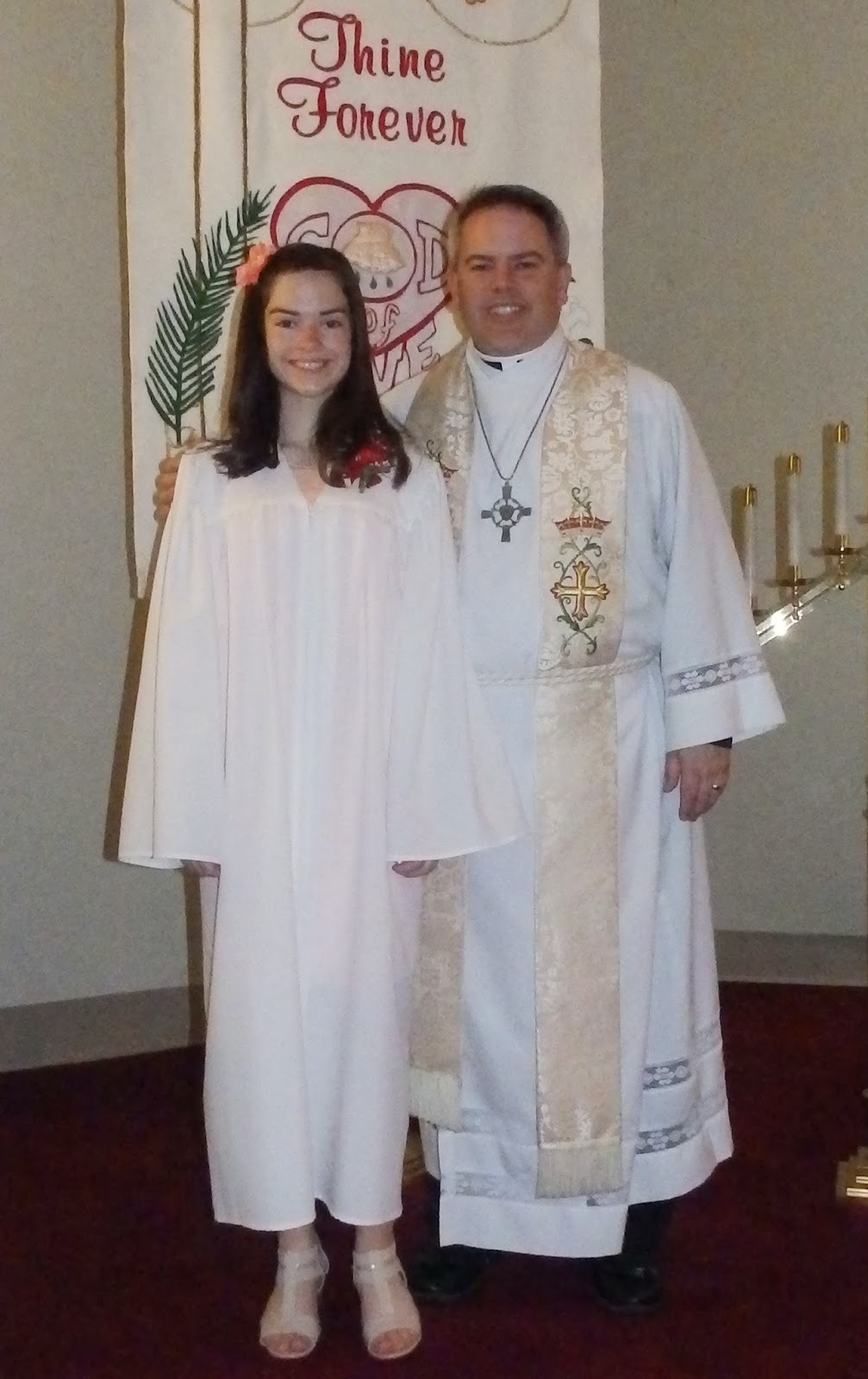
The confirmation of my daughter was a major event for my family yesterday (at least in terms of work and people involved).  All of her grandparents, aunts, uncles, cousins and godparents were present.  There was a meal and an open house with the requisite decorations, cake, mints and nuts.  Perhaps we fell into all the same clichés as every other family when it comes to confirmation.  But as I thought about what it meant that my daughter was confirmed, I came to the conclusion that for me, as a parent, nothing has really changed.  The presence of her family was an obvious statement to her that her growth in the Christian faith is of great importance.  However, my expectations for her have not truly changed now that she is confirmed.  Since our congregation links First Communion and Confirmation, her being invited to the table is actually of greater “significance” in terms of the fact that she now is blessed to receive the Lord’s Supper and all the blessings that our Lord offers therein.  But ultimately, my sincere hope is that she understands her identity as a baptized child of God.  To that end, I wrote her a letter that I gave to her last night after all of the day’s commotion subsided.  While she received many beautiful and generous gifts from her family and friends, I wanted to share with her what our hopes are for our future and those hopes have never really changed.   We want her to know what it means that she is God’s baptized, forgiven and redeemed child.   Here is the letter that I wrote to her. 

 
Dear Caroline,

January 9, 2000 on the church’s calendar was the Baptism of our Lord, but it was also your baptism.  The sign of the cross was made over your head and heart as Christ marked you one of His own.  As God placed His name on in you through the water and the Word, Christ’s baptism became your baptism, His death your death and His resurrection yours also.  You were brought into God’s Kingdom by God’s grace, the work of the Holy Spirit. 

There have been many important days in your life since.  There have been milestones such as learning to walk or the first day of school or losing your first tooth or making your first basket.  But on January 9, 2000, the hopes that your mother and I had for you were met as you were baptized into Christ.  There were lots of things that we hoped for in a child.  Healthy, smart, funny, kind with a warm smile and a love of Kentucky basketball (okay, that was just mine).  But more than anything else, what we wanted in a child was a child of God.  We wanted a daughter or son who would know Christ’s love and the riches of His grace.  We wanted a child who confessed the faith that we shared and would one day stand next to us and share Christ’s body and blood with us in the Lord’s Supper.  We weren’t so concerned about hair color or the shape of your nose.  We didn’t have strong feelings about your particular interests.  We simply wanted you to know that God loved you even more than we ever could.  We wanted you to know that Christ demonstrated His love for you by dying for you. 

So what’s next?  High school, college, additional schooling, dating, occupation, marriage.  We aren’t sure what all the future holds for you.  However, our hope for you doesn’t really change.  It remains our prayer that you are God’s baptized child.  There will be many pressures and temptations that you will face ahead.  But we still will pray that the God who marked you at the baptismal font will continue to keep you safe and secure in the “ark” of the Christian Church.  When you were still in the womb, your mom used to tell me how much you moved around when I was preaching.  She used to say that it was because you knew my voice.  I always thought it was more like John the Baptist leaping in his mother’s womb in the presence of the yet unborn Christchild as Mary visited Elizabeth.  I pray that you will always be faithful in hearing God’s Word proclaimed and being in the presence of Christ as He comes to you in Word and Sacrament. 

We never know what the future holds.  The only thing of which you can be certain is God’s faithful promises.  That is why I think your confirmation verse is so appropriate.  God’s Word of encouragement to Joshua is fitting also for you, “Be strong and courageous. Do not be frightened, and do not be dismayed, for the Lord your God is with you wherever you go.”  You may live across town from us or on the other side of the globe, but God will be with you.  May your strength and courage always come from the God who called you in baptism and who gave His life for you on the cross. 

This also guides you no matter what you “do with your life.”  Whether you are a doctor or a ditch digger, it is my hope and prayer that you see your work in light of your identity as God’s beloved child.  Paul describes it well in Galatians 2, “I have been crucified with Christ. It is no longer I who live, but Christ who lives in me. And the life I now live in the flesh I live by faith in the Son of God, who loved me and gave himself for me.” 

Caroline, you have been baptized into Christ’s death and resurrection.  You have died to yourself and now risen as God’s new creation.  So it is no longer you who live, but Christ who lives in you.  That means that Christ works through you whether teaching children or caring for the sick.  So whether it is wife and mother or worker or all of the above, may you find joy in being who God has called you to be – His beloved child!

There will be times that you fail.  There will be times where you make mistakes.  You are a sinner and that is what sinners do.  At those times, I pray that you find comfort at the baptismal font where you first received God’s forgiving word of Absolution.  You are just as much in need of God’s grace today as you were on the day of your baptism.  And you are just as much God’s baptized child today as you were on January 9, 2000. 

I am your father and that means that I have a great responsibility that I take seriously as I raise you as God’s baptized child.  But our relationship is more than just father and daughter and even pastor and parishioner.  It Is also that of brother and sister in Christ because just like you I am a sinner who needs God’s grace.  While there will perhaps be more years of me talking to you about the stuff the dads say to daughters, what we have to look forward to is an eternity as brother and sister in Christ.  I really look forward to birthdays and driving lessons, ballgames and college visits, graduations and if God blesses wedding and grandchildren.  Those will all be wonderful things for us to look forward to in the future.  But we are blessed to be able to look forward to the eternity that we will share because more than anything else we are God’s baptized children. 

Your mother and I love you.  We look forward to what the Lord has in store for you in the future and we rejoice that the future is an eternal one.  Thanks be to God for His indescribable gift of grace in Christ Jesus!

Love,

Dad


Friday, May 2, 2014

Reflecting upon Confirmation as a Pastor - What Does This Mean?


Confirmation has returned to the forefront of my mind in recent days for personal and professional reasons.  The practice of confirmation is one of the few issues where there is great unity among LCMS pastors these days.  However, it is not necessarily the kind of unity for which we are striving.  The unity that we have achieved is that of dissatisfaction.  Very few pastors are content with their particular congregational model or approach to confirmation, the participation and response of confirmands, and the support of parents and care givers.  In Confirmation Basics, seminary professor Kent Burreson describes confirmation as “a rite desperately seeking a rationale.”  He then refers to “its checkered liturgical history,” “diverse responses of the Lutheran reformers,” “changes in the practice” and “challenges in a post-modern, post-church age” as part of the background for assessing the practice of confirmation today.”  Many associate confirmation with the Lord’s Supper when it is associated with First Communion.  Others connect it with Baptism or emphasize it as something distinct from Baptism and Lord’s Supper by emphasizing the personal vow or the concept of “membership.”  Arthur Carl Repp’s classic Confirmation in the Lutheran Church provides a thorough overview of the history of the rite and the various approaches since the Reformation and traces how elements of the four distinct “types” have been retained.  While Repp’s book is fifty years old, he raises some of the same questions with which pastors and congregations wrestle still today.
The rite in Lutheran Service Book helps to strengthen the connection between confirmation and Baptism.  This helps to place confirmation within the understanding of Christ’s command to “make disciples” by baptizing and teaching.   It becomes in one sense a logical extension of the parent’s commitment in bringing the child to be baptized and the charge given to sponsors.  Confirmation is more than just a white robe and a cards for the boy wearing the uncomfortable tie or the girl walking awkwardly on her heeled shoes.  The explanation in Lutheran Service Book Agenda explains “The rite of Confirmation, though not commanded by Christ in Holy Scripture, is, nevertheless, a salutary custom that marks the catechumen’s confession of faith after a period of thorough and extensive catechesis in the Small Catechism.  It is also a celebration of the gifts that God gave the catechumen in Baptism and affords the confirmand the opportunity to confess his or her faith publicly before the Church.” 
As I searched through the files on my computer, I found three different documents that noted changes to our confirmation program and one “paradigm shift.”  I was surprised how many times we have “revisited” with confirmation without achieving any spectacular solutions.  My pragmatic side is frustrated that there is no “magic bullet” for confirmation.  However, there is still a great commitment to the confirmation in many congregations.  But we have to recognize that family dynamics have changed dramatically in the last twenty-five years.  Marvin Bergmann, also taken from Confirmation Basics, writes, “The three leading challenges in confirmation ministries anticipate five years from now named were the need for greater parent involvement and commitment, schedule conflicts and time pressures, and a post-confirmation lack of involvement by youth.” 
So, as Lutherans are prone to ponder, “What does this mean?”  We have this long-standing “custom” that is varied in terms it’s understanding and practice that is found by many to be difficult and frustrating.  There is no “Thus saith the Lord” attached to confirmation.  What then should we do?  Should we just read confirmation’s obituary and call it a day?  Perhaps a better approach than a funeral would be a “reformation.”  Confirmation is not something that can be “fixed.”  To properly instruct and prepare catechumens means that confirmation instruction will be in a constant state of flux as we strive to make disciples in a constantly changing world. 
What confirmation has traditionally been in most Lutheran churches in the previous century was a time of intensive instruction in the Christian faith in a time that paralleled adolescence.  Some congregations have moved away from confirmation taking place in eighth grade.  Admittedly, junior high is a challenging age.  However, it would seem that there would be great benefit to young people spending significant time with their pastor through catechesis.  Rather than retreating from the challenge,  it would seem to be wise to re-commit ourselves to the importance of teaching the faith at this age.
This also means committing to an approach for confirmation that is adaptable for today.  We cannot take the same approach to confirmation of years gone by.  This means that our approach to confirmation would be multi-faceted and would include parents, care givers and other adults in the process as well as individualized and group settings.  I would envision an approach that still makes extensive use of Scripture and Catechism, but would not be exclusively “delivered” by the pastor in a lecture format.  A seminary professor recently suggested to me that pastors would benefit greatly from taking an “educational methods” class from a local university.   It would be a worthwhile investment of time and resources for the congregation as well.  We must also recognize that catechesis today should include much more of an emphasis on apologetics than was the case previously.   Young people will find the Christian faith under attack as they set foot on college and perhaps high school campuses.  Catechesis will teach the faith thoroughly, but also help the catechumens to be able to answer and contend for the faith in a world hostile to the Gospel. 
For confirmation to serve any purpose beyond the confirmation robe being just a graduation gown, it will mean that congregations view it within an overall commitment to the teaching of children and adults.  This means that the commitment and support of confirmation is more than just an hour of the pastor’s time on Wednesdays and the grandparents who shuttle the kids.  What is needed is a commitment to instruction of children and adults that connects home and church (and Lutheran school) and places confirmation as one piece of a larger puzzle.  This means that pastors and elders and other committees regularly discuss and evaluate confirmation.  It means that parents are actively in engaged in teaching the faith within the home to their children as Luther envisions in the Small Catechism.  It also necessitates more discussions about confirmation between pastors and other church professionals regarding everything from First Communion to different learning styles.  These are topics to be taken up by conferences at the circuit and district level and by leaders at the university and seminary level (Dr. John Oberdeck at Concordia University Wisconsin has been a leading voice for this important topic). 
Ultimately, confirmation is about connecting the young people with Christ and His gifts given in Word and Sacrament.  Burreson writes, “Its purpose must always be to support and strengthen the Church’s Word-filled, sacramental life of faith.”  The hope and prayer of every pastor is that the child who is baptized into Christ will be present at the time of confirmation and that the young person who is confirmed will be present the next week to once again hear the Word and receive Christ’s gifts. 
 
If you've made it this far, check back on Monday for my reflections upon confirmation as a parent. 

Tuesday, April 29, 2014

Treacherous Times for Pastor and People - Rev. F.J. Biltz During the Civil War


“When [Rev. Franz Julius] Biltz accepted the call to Concordia, he perhaps little realized what great dangers he would encounter as pastor of the congregation,” wrote Lutheran historian August R. Suelflow.  Rev. Biltz was installed April 29, 1860, nearly a year before the Confederate troops attacked Fort Sumter.  In October 1860, the new pastor attended the convention of the Evangelical Lutheran Synod of Missouri, Illinois and other States in 1860.  He reported to the convention that the members of the congregation at that time totaled 325 souls with 86 students in the parish school.  The relative peace of life in the new parish would be short lived as the Civil War would tear the nation in two and the conflict reach as far as the prairie of Western Missouri. 

The conflict spread to Lafayette County already by the summer of 1861.  William Arndt, who served as professor at St. Paul’s College in Concordia from 1912-1921, wrote of Biltz, “The Civil War had been casting its shadows before it in Western Missouri and Eastern Kansas; but that his own little flock of honest, hard-working, peace-loving German immigrants would become implicated in such bloody affairs undoubtedly must have seemed to him a very remote possibility, if it entered his mind at all.”   According to historian Robert Frizell, Biltz would be interrogated by Colonel Edwin Price, son of Missouri State Guard commander and former governor, General Sterling Price.  While assurances were made to Biltz that the German community would be left out of the conflict, the rebel troops claimed guns, horses, and other goods from the residents of the Cook’s Store area (one of the early names for the community). 

The most personal brush with the conflict for Biltz would come the following year.  On October 5, 1862, Pastor Biltz went to the home of Julius Vogt to baptize newborn twin sons.  As Biltz joined the family and guests for a celebration meal after the baptisms, armed men took descended upon the gathering.  They would take Biltz and others prisoners, killing Heinrich Brockhoff and Heinrich Hartmann.  The band of “Bushwhackers” would wound a number of men, but eventually released Biltz and several others.  Biltz, would in turn, conduct the funerals of the men killed the very next day.

In the summer of 1863, four young men (Conrad Bruns, Louis Fiene, Dietrich Karsten, and William Scharnhorst) from the congregation had been killed by guerilla troops.  As the congregation gathered in the old brick church on the site of the St. Paul’s cemetery for the funeral, reports reached the assembled of approaching troops.  Arndt recounts the chaos that ensued, noting that Biltz remained in the pulpit until the elders pleaded with him to come down.  Once the congregation learned that the troops were approaching were Union soldiers, the funeral continued.  The history of St. Paul’s Lutheran Church notes that Pastor Biltz prayed, “God have mercy on our congregation and on our land.” 

The most deadly conflict with the Bushwhackers would come late in the war, in October 1864.  News reached the citizens of the community that the guerillas were once again in the area.  Approximately 100 men gathered at St. Paul’s to set out to meet the rebel troops.  Biltz was originally with the group that was setting out on horseback, but the tall man was encouraged to go with the other group on foot.  The group on horseback headed East while the group on foot went northeast.  The group on horseback encountered a larger group of the guerillas near Emma and twenty-four local men were killed, thirteen from St. Paul’s.  The second group, that included Biltz, met no enemy troops and returned safely home to the sad news of the deaths of so many.  Once again, Biltz would be called on to bring the comfort of God’s Word for a congregation and community saddened by grief and tragedy. 

In 2009, Biltz’s diaries were discovered in a collection of items from his grandson, Rev. Theodore Walther at Concordia Historical Institute (CHI) in St. Louis.  His diaries note significant milestones during the Civil War era such as comments about specific battles and the assassination of President Lincoln, in addition to his notes about community and parish life.  The diaries were featured in an exhibit at the CHI Museum housed at the Lutheran Church—Missouri Synod International Center. 

The days of the Civil War would eventually come to a close and the congregation and community would grow and thrive during the rest of the 19th Century.  Such growth continued even during the war as the congregation grew to 576 members and with 125 students in the school.  William Arndt summarizes the ministry of Biltz during these treacherous times, writing, “It was in times like these that the faith of the founders and first members of our Synod was tested.  Pastor Biltz, in spite of an alluring call into safe territory, remained with his little flock in the war-torn area, conceiving it to be his duty no to forsake  it in these days of temptation and sorrow.  His heroic devotion to duty constitutes one of the fine pages in the early history of our church-body.  It was but natural that soon the Western District looked upon him as one of its leaders and after the lapse of several years elected him as its President, a position which he occupied with honor for seventeen years.” 

Rev. Dr. Lee Hagan

 
A thorough treatment of the history of the German immigrants who founded the community of Concordia, including the local skirmishes with the Bushwhackers is Robert Frizzell’s book Independent Immigrants: A Settlement of Hannoverian Germans in Western Missouri, published by University of Missouri Press.  Frizell will speak at St. Paul’s on June 15 in the afternoon as part of the congregation’s 175th Anniversary. 

An article about the discovery of the Biltz diaries was featured in Lutheran Witness in June 2009.  http://blogs.lcms.org/2009/uncovering-history-6-2009. 

Friday, April 25, 2014

The Sights of Dublin and St. Mark


Nearly twenty years ago, I hopped into a cab with a friend in Dublin and told the cabbie to take us to the Chester Beatty Library.  He turned back in confusion and said, “Where?”  I just assumed that anyone who lived in Dublin, but especially a cab driver, would know about the world famous Chester Beatty Library.  This famous museum houses perhaps the greatest collection of ancient and Biblical manuscripts.  Surely, this place is familiar.  But to my disappointment, he had never heard of it. 

Upon arrival, we inquired about seeing the manuscript collection.  As they we were preparing for new exhibition, the collection was not available for viewing.  However, the person agreed to find the curator.  When the curator asked about our interest and we specifically referred to papyrus manuscripts 45 and 46, the expression on his face changed.  He immediately brought us back to the new exhibit and gave us the chance to see the collection of manuscripts.  What was especially meaningful for us was to gaze upon a portion of St. Mark’s Gospel, dated from the early part of the 3rd Century. 

April 25 is the date on which the Church commemorates St. Mark the Evangelist.  While we do not have Mark’s “autograph” (the handwritten manuscript from the evangelist himself), we can have great confidence in the Biblical text that we read today.  We often find critical Christian scholars calling into question the Biblical text because of variant readings from one manuscript to another.  However, the vast majority of variants are of minor note and are usually related to matters such as word order or grammatical differences. 

Mark is often connected with St. Peter according to tradition.  This young man, who was the cousin of Barnabas, shows up several times as his mother’s home is some sort of base of operations in Jerusalem (as indicated in Acts 12) and as he is included on Paul’s missionary journey.  In fact, as Mark would abandon Paul and Barnabas, whether to include him on the subsequent journey led to the break between the two.  However, Paul’s later letters reveals that he and Mark had been reconciled and that Paul found him useful for his ministry (2 Timothy 4). 

There is much debate over which of the Synoptic Gospels (Matthew, Mark, and Luke) came first.  Most scholars contend that Mark preceded the others and that Peter was a primary source for his composition.  On a day such as this, we can thank God that He has preserved His Word among us and by that Word He has revealed to us the Person and work of His Son, Christ Jesus.  We can be thankful for the faithful witness of St. Mark.    His Gospel is precise and to the point on one hand, but gives a primary emphasis on the events of Holy Week.  We can be encouraged in the faith by the second Gospel’s revelation of Jesus as the Son of God. 

So if you’re ever in Dublin, make sure you go to Christchurch Cathedral.  You should also see the Book of Kells at Trinity College.  The Guinness Brewery tour is a fun distraction too.  But make sure you make it to the Chester Beatty Library and see P45.  Or if Dublin’s too far, they have a portion of the collection at the University of Michigan.  Either way, thanks be to God for the faithful witness of St. Mark. 

Collect for St. Mark, Evangelist – Almighty God, You have enriched Your Church with the proclamation of the Gospel through the evangelist Mark.  Grant that we may firmly believe these glad tidings and daily walk according to Your Word; through Jesus Christ, our Lord, who lives and reigns with You and the Holy Spirit, one God, now and forever.  Amen. 

Wednesday, April 23, 2014

Franz Julius Biltz - Pioneer Pastor


Franz Julius Biltz - “Pioneer Pastor”

                One of the most familiar names associated with the community of Concordia, Missouri,  throughout its history has been Rev. Franz Julius Biltz.  He would serve as pastor of St. Paul’s Lutheran Church actively for 41 years and 7 years in retirement.  He was also instrumental in establishing St. Paul’s College and even served as the first postmaster.  One lasting legacy of Biltz was his coining the name of the town, “Concordia” in 1860.  Famed Lutheran theologian, P.E. Kretzmann,  described Biltz’s leadership in Concordia, “Once a pioneer, always a pioneer!”

                Franz Julius Biltz was a thirteen year-old orphan when a group of German Lutherans left their home country for religious freedom in the United States.  There were more than 600 Saxons who had left the increasing oppressive religious climate destined for the United States, particularly Missouri.  The presence of Biltz among the immigrants was actually a source of scandal as he left with his adult sister, but without the consent of his legal guardian.  A legal notice was placed in the local newspaper that sought his apprehension and anyone involved in his “escape.”  Biltz would remain in hiding for nearly a month until the Saxons would leave Bremershaven, Germany on November 18, 1838. 

                As the Saxon immigrants began to settle into Perry County, they immediately built a log cabin that would serve as the schoolhouse for the students.  This is recognized as the beginning of Concordia Seminary, which today is located in St. Louis.  There were eleven students who were in attendance on the first day of classes on December 9, 1839 in Altenburg.  (The original “log cabin schoolhouse” is maintained at the Saxon Lutheran Memorial in Frohna, Missouri.  A replica of the log cabin is found on campus at Concordia Seminary in St. Louis.)  Among the first students were both Franz Julius Biltz and Maria von Wurmb (a nine year old, who would go on to marry Biltz).  In the early years, teaching responsibilities in the school were carried out by Pastor C.F.W. Walther and three seminary trained men who would in time receive calls to serve congregations, Friedrich Buenger, Theodore Brohm, and Ottomar Fuerbringer.  As his studies moved beyond the basic “gymnasium” level of training to seminary level instruction, the primary teacher was Gotthold Loeber (as the other men had all received calls outside of the Perry County area). 

                Biltz was in attendance at the formation of The Lutheran Church—Missouri Synod (known then as the German Evangelical Lutheran Synod of Missouri, Ohio and other states) in 1847 as he was presented as a candidate for ordination to the convention.  Biltz was the second graduate of Concordia Seminary after completing his studies (still in the log cabin) in 1848.  He was ordained at Trinity Lutheran Church in Friedheim, Missouri.  In 1853, he accepted a call to Maryland to establish a congregation in Cumberland.  Biltz would serve in Cumberland until 1860 when he accepted the call to return to Missouri, serving a growing congregation in Lafayette County, Missouri (today known as St. Paul’s Lutheran Church in Concordia). 

St. Paul’s Lutheran Church in Concordia will begin a year-long celebration of its 175th Anniversary on May 25, 2014.  Pastor Biltz was the longest-serving pastor in the congregation’s history.  This is the first in a series of four articles about Pastor Franz Julius Biltz.

Tuesday, April 22, 2014

Good Friday Sermon - "Behold the Man!"


I.N.I

Good Friday - John 19:5  “Behold the Man”


“So Jesus came out, wearing the crown of thorns and the purple robe. Pilate said to them, ‘Behold the man!’”


            Adam was THE Man!  The original man!  One of a kind.  There had never been another like him because…He was the original man.  God had created the Man in His own image.  He had created all the earth and the fullness thereof for the Man to rule over and to subdue.  God even created a suitable helper for the Man.  God’s perfect love for the Man was seen in the perfect state that He had created for the Man.  All He asked of the Man was for Him to fear, love and trust in Him.  So for a moment, the Man enjoyed the perfect beauty and splendor of God’s creation.  There was no strife or discord.  There was no bloodshed or warfare.  There was no pain or suffering.  Everything that the Man and the Woman saw was good and yet even that was still not good enough. 

            The Man fell.  The Man was not satisfied with the gifts that God gave.  The Man did not trust in God above all things.  The Man sinned.  But God promised that the offspring of The Man and The Woman would come to rescue The Man.  The Man who would come after would be the kind of man that The Original Man was supposed to be.  So when the Man lay with The Woman and their union bore fruit, there were great expectations.  What kind of man would this be?  Would this man be greater than the original man?  Would he be the kind of man that the Original Man was supposed to be?  Those expectations are heard the words of the woman after giving birth.  She declares, “I have gotten a man, with the Lord’s help.”  Not a son.  Not a child, but a man.  Luther even reads into Eve’s words a bit to suggest that she expected that this child would be the fulfillment of the Messianic prophecy.  But this Man that the Woman had gotten was hardly the Man for whom she hoped.  Cain was his name, taken from the Hebrew word for gotten.  He was not greater than the original man.  In fact, he was a flawed sinner just like his father before him.  This Man was the kind of Man who killed his own brother in a fit of jealousy and rage.

                So from Cain on, the descendants of the Original Man had been the embodiment of sin.  Their hands were stained with blood.  Their mouths opened to spill forth lies.  Their eyes were not ever on the Lord, but glistened with lust and desire.  Contentment could not be found in the descendants of the Man because they always wanted more.  They were enslaved by an insatiable appetite and thirst for more. 

                The prophet Nathan came to King David, a descendant of the Original Man, and the ruler over God’s chosen people.  God had given him everything and if that had not been enough He would have still given Him more.  After David’s adulterous affair with Bathsheba and murder of Uriah, the prophet Nathan tells him of a rich man who steals from a poor man.  When David flies into a rage at the story, Nathan pierces David with the poignant words, “You are the Man.” 

                Let’s be very clear about who you are this evening – “You are The Man.”  Ladies, you too.  You are the fallen sinner.  You are the murderer and the adulterer.  You are the liars and the cheats.  You are the ones who hate and hurt, who cook the books and exchanging lust-filled looks.  Like Adam and Eve, like David and Bathsheba, like all those who have gone before us, You are the Man!  You are the sinner!

                But Pontus Pilate brings Jesus out before the crowds, covered in blood and sweat from his head to his feet, with a purple robe of mockery draped over him a thorny crown pulled down piercing his brow.  Pilate presents him to the throngs of people and declares, “Behold the Man!”  The King of Glory humbles Himself by taking on the servant’s form and being numbered with sinners.  This place of judgment is where sinners belong and yet Jesus takes Adam’s place.   Behold the Man!  He becomes the substitute for Cain and Abel, for David and Uriah!  He becomes the Man that you never could be in keeping the Law perfectly, but He also becomes the Man that you have always been by suffering our punishment and bearing the weight of our sin!  God made Him who knew no sin to be sin for us.  Behold the Man!  Jesus became the Man of sorrows for us, to save us and to give to us forgiveness and life. 

                Like Adam, Barabbas was the Man!  He wasn’t the kind of man that he was supposed to be, but he was the man!  A notorious criminal.  A scoundrel.  A wretch.  He found himself imprisoned and that is exactly where he deserved to be.  And yet this man’s place is taken by Jesus.  “A criminal they save, the prince of life, they slay.”  Barabbas was the Man, but Jesus took his place and He became the Man for Barabbas!  When Pilate presents Jesus to the crowd and sends him off to His death, it is not just Barabbas’ place that Jesus takes, but all of ours.  This is why the cross tops steeples and hangs on walls.  It is why it covers facebook pages and marks foreheads and hearts, for it is in the cross that our salvation is realized and we become the Man and the Woman that God intended as we trade our sin for Christ’s righteousness. 

                St. Paul distinguishes between the Original Man and the Perfect Man in Romans 5.  He writes, “But the free gift is not like the trespass. For if many died through one man's trespass, much more have the grace of God and the free gift by the grace of that one man Jesus Christ abounded for many.”  Thanks be to God that Jesus became the Man for us!  And through this One Man, grace abounds for you.  Jesus, true God and True Man, for you!  Behold the Man! 

S.D.G.

Rev. Dr. Lee Hagan

St. Paul’s Lutheran Church

Concordia, Missouri

April 18, 2014

Monday, April 21, 2014

"Fear and Great Joy" - Easter Sermon, 2014


I.N.I

Matthew 28:8 “Fear and Great Joy”


So they departed quickly from the tomb with fear and great joy, and ran to tell his disciples.”


                When Mary Magdalene and the other Mary reached the tomb, it doesn’t take a lot of assumptions to determine that they were emotionally frayed.  If you consider the roller coaster that Holy Week is for us, nearly two thousand years removed, it was even more traumatic for those who went from the cries of Hosanna to the cries of Crucify Him to the cry “It is finished!”  They had followed him from Galilee and care for him and had been forced to standby and helplessly watch him writhe in pain as he struggled for each breath, until he cried out and breathed his last.  So they set out for the tomb in many ways overcome by the emotions of the previous days.  But then when they arrive, an angel of the Lord announces that Jesus has risen just as He said He would.  The angel sends them to announce this Good News to the disciples and that they will see him in Galilee.  As they departed, these emotional women are filled with two new and seemingly contradictory emotions – fear and joy. 

                John McLoughlin and Will Jimeno were just two guys on the job.  They were Port Authority police officers in New York city which mean that there were responsible for bridges, tunnels, airports, seaports and other locales, including the World Trade Center.  On September 11, 2001, they were just like thousands of other people in New York City, two guys on the job.  But as the first plane crashed into Tower One of the World Trade Center, McLoughlin and Jimeno and hundreds of other Port Authority police officers and other emergency personnel responded.  They were in Tower One, preparing to head upward to assist in the evacuation when the tower collapsed.  The men ran toward the elevator shaft as the building came down all around them.  McLoughlin and Jimeno found themselves trapped within a mountain of steel and cement.  For hours they lied there in the rubble – injured and pinned by debris.  No one came to their rescue.  There they were trapped and waiting to die.  After the search for survivors had been called off because of the darkness of night, two former Marines continued searching on their own.  Eventually, they heard McLaughlin and Jimeno and a desperate rescue effort began.  When the two men were found, they were overjoyed.  They had almost given up hope.  It is captured in the movie World Trade Center when Jimeno says to the Marines, “Don’t leave us” and one responds, “We’re not going anywhere.  You are our mission.”  But just because the men had been found, just because they were filled with joy did not mean that all of the fears were gone.  When their wives were notified that they had been located, there was great rejoicing, but there were still things for which they were afraid.  The men were still trapped.  Rescue efforts were risky.  It was slow and pain-staking work.  They had fear and great joy.  It took thirteen hours to rescue Jimeno and twenty-two hours to free McLoughlin, but they both survived. 

                Dear friends, Mary and Mary leave them tomb on that first Easter with fear and joy.  In many ways that is how we function in this fallen world.  We know that Christ has risen again from the grave.  We know that He will come again in glory on the Last Day.  But we still find ourselves laboring here in the Valley of Tears.  We still live in a fearful world where men shoot at people in cars for reasons beyond imagination.  We live in a fearful world where more than 200 Christians in Nigeria by militant Muslims.  We live in world of hunger and homelessness, sickness and poverty.  We know what Christ has risen, but like McLoughlin and Jimeno, we still find ourselves stuck in the rubble.

                But the rubble is often of our own making.  As a pastor, I once found myself with my hands joined with another man’s as I prayed.  But he was trapped, enclosed in a cage at the city jail on attempted murder charges.  After we prayed, we sang.  It was Christmas Eve and there was still much for which He could rejoice.  He was a sinner, who had become enslaved by anger.  But from his pastor’s lips, he had heard the gracious Word of Absolution, that He was forgiven of this sin.  So there the two of us sang, Silent Night, Hark the Herald Angels Sing, and Joy to the World.  There were still fears about his punishment.  There were fears about his relationship with his wife and children.  There were fears about the future.  But on account of Christ’s resurrection, there was joy, even while he was stuck in the rubble.

                Dear friends, there are still things for which you find yourselves afraid.  We are sinners and how often our lives have been reduced to rubble because of our selfishness, because of our anger, because of unfaithfulness, because of our sin.  But Christ’s resurrection sets us free from the sin that so easily entangles us.  Christ releases us from the bonds of that held us.  We were once trapped, but through Christ Jesus, we are now freed by His grace.  That is what gives us joy! 

                The men trapped in the rubble – they were exactly why those two marines came.  They were their mission.  Dear friends, you were Christ’s mission.  You were trapped in the rubble of your sins.  You were exactly why He came to earth.  You were exactly why He suffered on the cross.  And you were exactly why He rose again from the grave.  No matter what fears you face, Christ Jesus has risen again to give you joy.  Yes, we live in a fear-filled world.  But the one who is in you is greater than the one who is in the world.  Christ has conquered His enemies of sin, death and the devil, by rising again from the grave.  This is the source of our joy!  This is the source of our singing.  For joy is not based upon our circumstances, but upon our relationship with Christ.  The grieving widow sings the hymns with great joy.  The young couple that is just barely scraping by sits together in the pew, rich in God’s grace and filled with joy.  The forgiven sinner may have made a mess of his life, but before God he knows that all things are made right and therefore he has great joy.  No matter what problems you left at home and will still be waiting for you when you get back – O beloved in the Lord – Jesus has risen from the grave.  Sin and death have been conquered for us.  We have all that we need in Christ.  Even in the rubble of our lives, we still have joy because CHRIST IS RISEN!  He is risen indeed.  Alleluia!  Amen. 

S.D.G.

Rev. Dr. Lee Hagan

St. Paul’s Lutheran Church

Concordia, Missouri

April 20, 2014